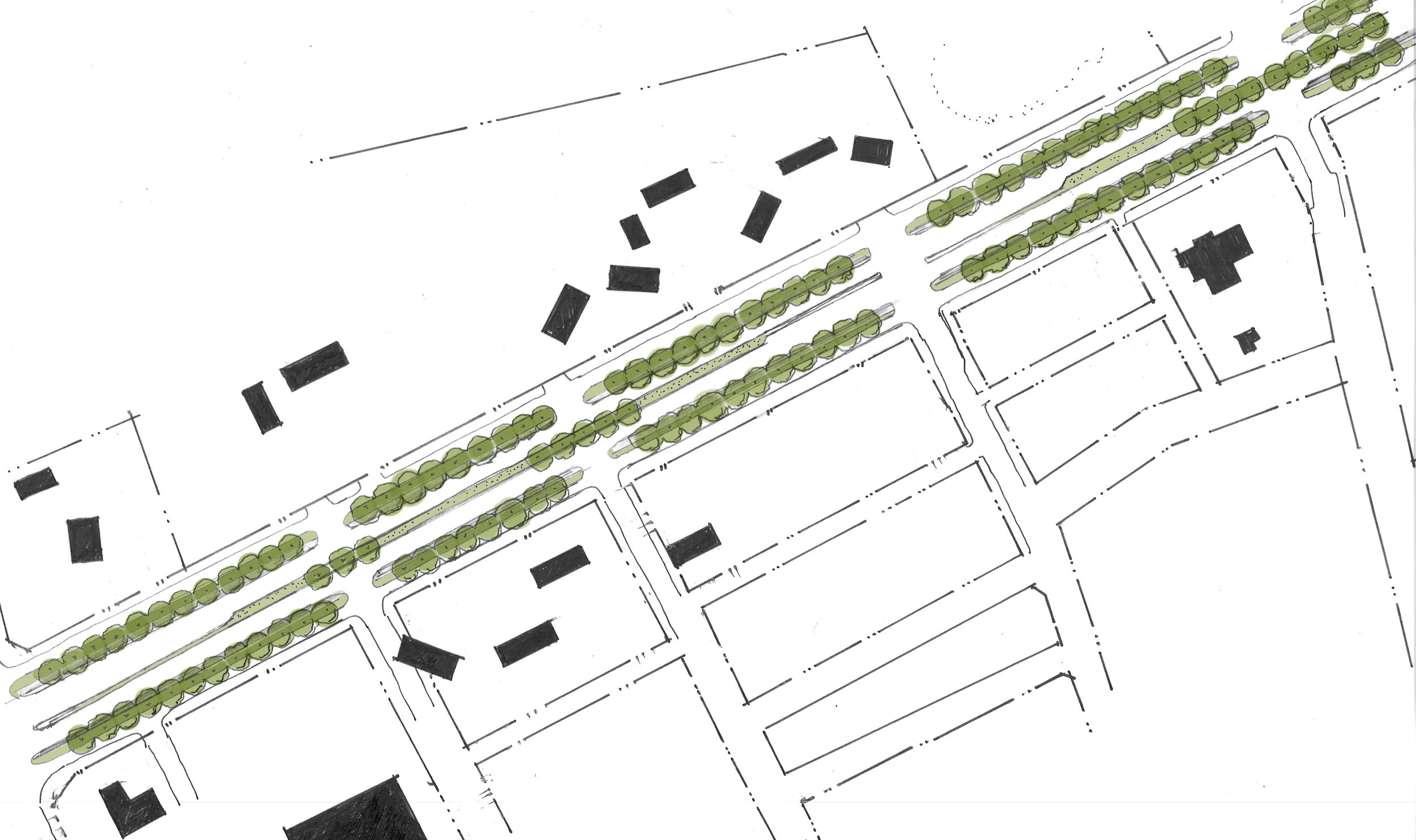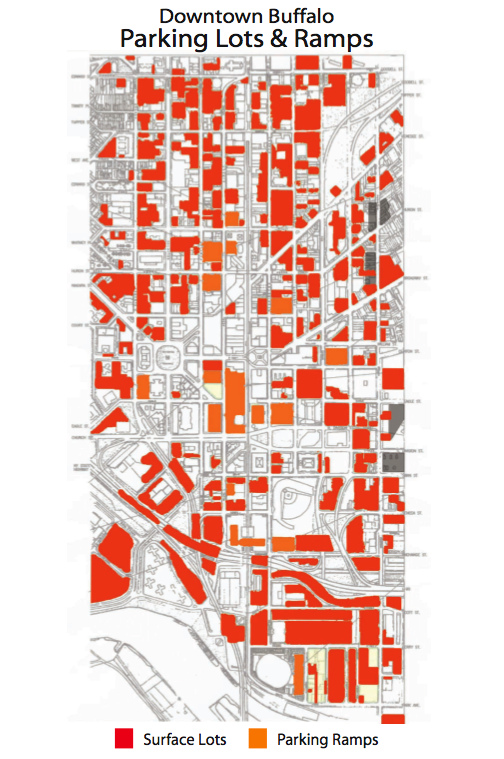
Parking in Downtown Buffalo, NY. A stark example of a city that has prioritized affordable places to house cars (--regardless of the cost or consequence).
In an email exchange with my Architect friend (and aspiring developer) Sara Hines in Massachusetts, she asked "Okay, so I really want to build better places. What towns in New England are going to let you build small scale walk-up buildings as-of-right, without requiring a lot of off-street parking?"
Good question. More likely than not, you will have to satisfy some local version of a dumb minimum off-street parking requirement. This is particularly unfortunate and wasteful, since municipalities are genuinely terrible at guessing how much parking is actually needed. Let's just call it what it is. Parking Bloat.
With off-street minimums, parking becomes the driver of what can be built and what a developer can afford to pay for land. (also called the "land residual" in finance speak). Simply put --you can only build what you can park according to the rules. That drives down the price you can afford to pay for the land.
There is some minor good news if you have an appetite for parking reform. Since the requirement for off-street parking just reduces what can be paid for the land, you may have an opportunity for some arbitrage as a small developer. Think of excessive off-street parking as a land bank. A piece of the parcel that needs to be set aside in the right configuration so that it might be built upon later, (after the rules change). The strategy to deal with this is to provide the unessessary surface parking so that it is configured to be converted to building pads later. To do this you need to keep the utilities out of the future pad and watch out for how the site drains.
Another strategy is to build actual garages to provide some of the required off-street parking. You can rent out garages at the same rate per SF as local self-storage (or more). Let's face it. They will end up being used as self storage anyway, but in the mean time they are a rent paying work around for
Parking Bloat.
If a municipality is serious about the economic and cultural benefits of places worth caring about and they want to provide a greater range of options for where people can live and work, they will eliminate off-street parking requirements. If they won't take that step, I wouldn't trust their well-intentioned planning efforts. It is clear that they are somehow just not equipped to do the most basic thing. Parking Bloat is a telling metric for figuring out how a town works. It could mean the elected officials and staff may not know what they are doing. It could also mean that they know what needs to get done, but for some reason, cannot get it done. Either way, the effect is the same. The small developer/builder should watch out for surprises in dealing with the planning staff and elected officials. If the community is crippled by Parking Bloat, land will cost less and you will have to build less initially. So don't overpay for land and start working on getting rid of the regulations that require Parking Bloat.
Don Shoup's book
The High Cost of Free Parking is out in paper back for $28.
Make sure your local public library has several copies. Give copies to the leadership of your town's various neighborhood associations and to the prime movers at the local chamber of commerce. With a little luck, the Town will do the right thing and you may create a couple of building sites down the line within the projects you built under the old bloated rules.