Plain talk on building and development
Test Img - Chico2.png

Blog: Plain Talk

Plain talk on building and development.

So, why can't we get a Trader Joe here?

People keep asking me "When are we going to get a real grocery store in Downtown East Point?" That's a legitimate question, but the answer requires learning a bit about how the folks who operate grocery stores decide to put a store in one community over another community.

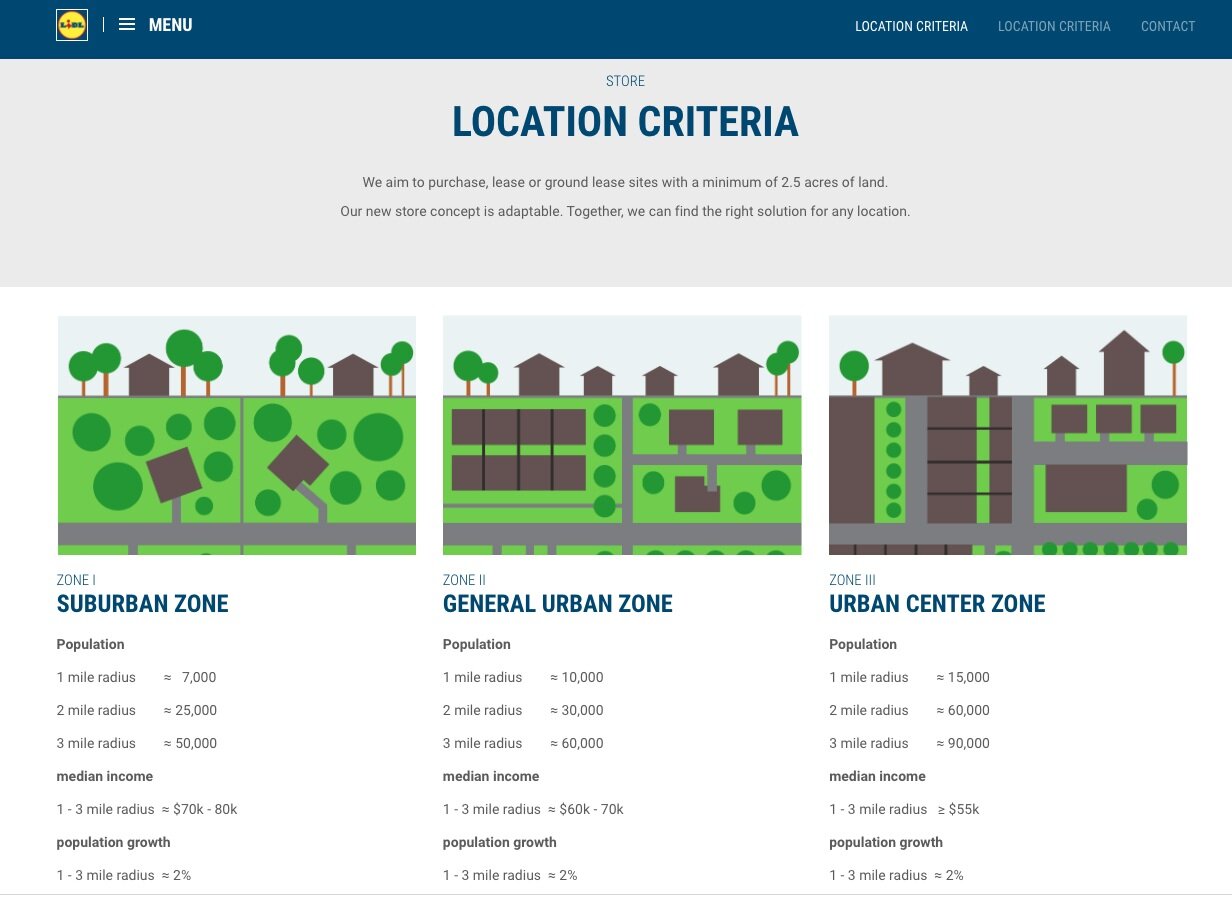
Here is a very straightforward set of location criteria for LIDL grocery stores. The LIDL folks break it down based upon the local context. Is the site in a Suburban setting, a neighborhood center, or a downtown urban setting? Each has a population requirement within the service area and a median income for the service area. The more spread out the development pattern, the more money each household needs to make.

This is pretty much how a retailer looks at a potential location. Where will the customers come from and how much money do most of the potential customers make.

A secondary set of metrics have to do with the other retailers in the same area, competitors and complimentary anchor institutions or retailers. They want to know who else is operating in the same local market area.

We have a 17,000 SF building on Washington Road which would be suitable for LIDL, but our city's median household income is less that the threshold needed to recruit LIDL to East Point.

Our population is 34,875 and our Median Household Income is $40,882. In order to have our site considered by LIDL we need more folks living in East Point and we need folks in East Point to be making more money.

Until the number of people living in East Point increases and until our residents make more money, retailers like LIDL , ALDI, Trader Joes and the rest will continue to locate their stores in places that hit their numbers.

If you google the name of the store you would like to see in your neighborhood with the words "site selection criteria" you can find out pretty quickly what it will take to get their attention.

rjohnanderson
How do we face the Monster and find our resolve?

Last night the 3rd Police Precent building in Minneapolis burned. Social media is going to be full of folks trying to make sense of recent events in Minnesota.

After listing to the news this morning and walking the dog around the neighborhood, here are my thoughts:

We are hearing the term Systemic Racism a lot. So let's unpack that term. It is really horrible to face the reality that we have a cultural system in place that ends up getting black and brown folks killed at the hands of local police. That same system produces other effects and impacts; lousy housing, physical and mental health, economic inequity hit black and brown folks harder than most white folks. Roll all that heartache into a glacier of needless suffering and most white folks can't face it. We have a hard time recognizing that we could ever be personally culpable in something that evil. If we come to terms with being part of that monstrous system, then what?

Systemic Racism is a big and formidable monster. I think the enormity of the problem is why people with even a little bit of privilege feel a need to deny that they have a part to play in building a new system. It is hard to know where to start, what to do differently, or if you can even trust your own mind, knowing that racism has a grip on some dark corner of your mental real estate.

Let's face it. White folks can be really embarrassing sometimes. We can also be really dangerous to black and brown folks and extremely clueless at the same time. These are the same privileged people that need to find the resolve to face the monster and resist the temptation to rationalize the evil they have seen.

A culture and system that has the evil of racism baked into it is not going to somehow evolve into something better with the fullness of time. We cannot not be satisfied by doing work that results in a slightly less shitty system.

For something that runs this deep we need to build a radically different alternative on purpose. It will require a lot of work to push the needle from shitty, well past neutral, to something excellent and equitable. Can that be done in a generation? It is hard to commit to a task that will not be completed in your lifetime, but that does not mean we shouldn’t do it.

The pandemic and the Covid 19 Recession are presenting us with the opportunity to make a dramatic shift in building trust and equity in our local communities. It would be great if we could look to our political leadership for inspiration and meaningful guidance in this time, but that is unlikely. The work that needs doing is going to be at the scale of individuals, households, neighborhoods, and local communities.

I don't know what that work needs to be, but I am convinced that the scale and location of where that work needs to be done is extremely local. We will probably have to figure this out as we go, but change is only going to happen at the speed of building trust. Trust is built between individuals long before it is built between individuals and institutions.

Boarded up duplex in New Orleans

MAY 29, 2020

nola double.jpg
rjohnanderson
Helping Your City Go Broke When You Know Better is Borderline Criminal
18 x 60 shot gun cottage for Columbus

18 x 60 shot gun cottage for Columbus

Do you know where your town comes up with the money needed to repave streets, expand the sewer plant, pay cops, firefighters, teachers, and bus drivers?  Most municipalities rely upon a combination of sales taxes, utility bills, impact fees on new development, and the big reliable source of money for the General Fund and Capital Project: property taxes.  Property taxes are assessed according to the value of the buildings on a parcel.  The more a building is worth, the more taxes the building owner pays.  Once a building is built, there is a good chance that it will be the basis of the property taxes that will be collected for a very long time.  It makes sense for a municipality to know how much taxable value-per-acre a given pattern of development yields, since there is only so much serviced, develop-able land within its borders.  Joe Minicozzi of Urban3 does a good job of explaining this fairly obvious math in this video .

The straightforward little two bedroom cottage above is proposed on a 37.5' X 135' lot  in city with a minimum lot width of 50 feet.  There are lots of existing platted lots with water and sewer taps in an established and desirable neighborhood that are less that 50' wide.  A vacant lot in the neighborhood pays about $70 a year in property taxes.  Removing the minimum lot dimension from the local zoning code would make it possible to build modest houses like the one shown above, but like many places, the city foolishly decided to downzone its established neighborhoods a couple decades ago.  That downzoning in favor of a more suburban model damaged their tax base.  There are roughly eight 37' X 135' lots in an acre.  If this little two bedroom cottage sold for $135,000 X 8 lots to the acre, the result is $1,080,000 in taxable value per acre.  Compared with the taxable value per acre of the biggest fanciest Super WalMart in the same zip code at $520,000 per acre.

When a developer builds a shopping center of residential subdivision these days, it is fairly typical for the developer to turn ownership of the new streets, sewers and other utility infrastructure over to the municipality.  If the taxable value of the new development does not produce enough money to pay for the repaving of the street or the repair and replacement of the other infrastructure when it wears out, this turns out to be a lousy deal for the municipality.  The developer has essentially given the municipality a free Great Dane puppy.  Unless that dog gets a job, it will be a long term financial drain.

Getting senior staff and elected leadership to recognize the looming cost of replacing and repairing infrastructure in parts of the city that cannot pay their way is going to be difficult. Coming to terms with this structural and systemic failure cannot be done with short term impact fee patches. The problem is bigger and more expensive than what can be laid off on new buildings. The source of the problem comes from building a place with the wrong pattern of development over decades. If you build in a way that spreads civilization too thinly, (Auto-only Sprawl) what gets built cannot support the repaving of roads or the repair and replacement of other infrastructure, let alone paying for cops, fire fighters, schools, parks, libraries, and public health services. If towns and cities create big backlogs in infrastructure repair that they cannot pay for, the financial burden becomes so great that people elected to two or four year terms end up just ignoring the problem and resisting any effort to do the honest math that will force folks to face how much taxes are going to have to be increased to cover the repair and replacement costs that are coming down the line.  This is big money with big consequences.

If you cannot do the math to understand the taxable value per acre of serviced land, you should not be in local elected office or running a municipal department. I recognize that this is typically a problem of ignorance and not one of deliberate malice, but the effect is the same in either case. We have to build differently to provide folks with greater opportunity, but we also have to build differently because towns and cities cannot afford the financial fall out of the wrong development pattern. A town going broke while while elected officials and senior staff are ignorant is unfortunate, but kinda understandable. Going broke when you know better is borderline criminal.

So what pattern is your town going to build in?  Is anyone doing the math?