Plain talk on building and development
Test Img - Chico2.png

Blog: Plain Talk

Plain talk on building and development.

Which Code? The Building Code? The Zoning Code? -you gotta be more specific....

Building Codes, the International Residential Code (IRC ) and the International Building Code (IBC) are written to start out as model codes adopted by the International Codes Council (ICC). These model codes are adopted in to state law in total, or in part, with, or without the model appendixes, and with, or without additional modification by individual states, (It is always important to refer to your state’s version of the model building codes, otherwise you will miss the local modifications and amendments…..)

Some states provide a window of time for municipalities to further amend or modify the State adopted version of the model code. After that window closes, the local municipalities that have not modified the State adopted version of the model codes are typically required to adopt the state version. Some states allow municipalities to decide which year's code they will be using. One town may be operating under the 2012 IRC and IBC while the city next door is on the 2015 version. Municipalities publish information on which edition of the model codes they have adopted. by city council action. Check your town’s website or ask at the counter in the Building Department.

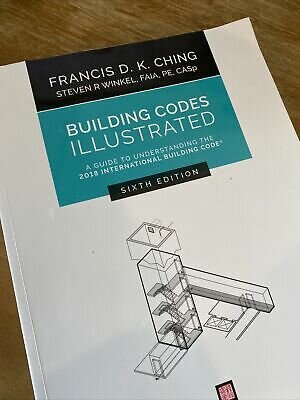
I recommend Francis Ching’s great book pictured above; Building Codes Illustrated if you want to have a good handle on how codes are written and interpreted.

Francis Ching’s indispensable book on Building Codes.

Francis Ching’s indispensable book on Building Codes.

Because Building Codes start out as model codes with a formal revision process at the International Codes Council, the standard of care and precision with which they are written is pretty high. The revisions also need to be consistent with the intent of protecting public health and safety.

Zoning codes on the other hand, are written and adopted at the local municipal level and rarely follow the same standard of care or attention to intent and consistency found in Building Codes. It is painfully common to find a zoning code that contradicts and prohibits the policies and actions set forth in the municipalities adopted Comprehensive Plan or General Plan.

Because zoning codes have been used to reinforce segregation the chances are pretty high that they still have plenty of Exclusionary provisions. They commonly have expensive off-street parking requirements that have no basis in science or good practice. These are typically not rules that were thoughtfully crafted by wise grownups looking after the public interest. If you local zoning code was written in 1979 or earlier and then amended over the years, there is a very good chance that you have rules on the books that contradict the policies adopted in your Comprehensive Plan or General Plan.

Your downtown may be regulated by a heinous bullshit zoning code originally written to insure the predictable development of strip shopping centers in a town in Iowa and imported to your place.

Your zoning code probably treats anything from a duplex to a 30 units to the acre apartment complex as if rental apartments are some sort of noxious land use that should be regulated like a steel mill or a hog rendering plant. Don't be surprised if your zoning code treats sections of town that exclude everything but single family homes as the ideal, and everything else like a problem that must not effect of impact the Single Family House subdivisions build under Exclusionary Zoning.

Check out this conversation with the author of The Color of Law to learn more about Segregation and Exclusionary Zoning practices:
https://www.youtube.com/watch?v=9Pb6y9rNKmo


rjohnanderson
First Project? Here's the best advice I can give a rookie developer

Some general advice for the folks approaching their first project:


A four-plex is a big first step for a new developer. Too big in my view. I think it is better to renovate a house or at most a duplex presents a lot of advantages in scale and complexity your first time out. Hone your craft on a first project that requires less capital and presents less risk . A renovation, a House Hack, an ADU, a flip within the neighborhood you will continue to work are a better fit for a freshman project.

If you are cooking a new recipe for the first time, no matter how much support and encouragement you might have, no matter how many times you have read the printed recipe or written the shopping list, at some point you have to actually cook the thing. There will be things you learn in the process of cooking that you did not pick up on reading the recipe or talking with people who cook the recipe all the time. Start small and learn.

A duplex or a four-plex both have the same sequence. Your financing for either project will be in two stages:

1.) A construction loan for a year or two that will require a downpayment (equity) of 25-30% of the cost of the project.

2.) A 30 year standard mortgage from FHA, VA, Fannie Mae, or Freddie Mac to pay off the short term construction loan.

If you are creating enough value with the construction or renovation of the building, you may be able to take enough cash out at the closing of the 30 year mortgage to pay off an investor or a family member who lent you the rest of the money you needed to have the down payment on the construction loan. The some of the various loan programs above have limits on cash outs. A four-plex is going to require more capital, a larger down payment on the construction loan. t's best to take the next small step unless you are partnering with a seasoned developer. Even then the first time you go solo there will be a lot of learning curve to overcome.

An added caveat. Your first project is going to be a side hustle, since you are probably depending upon other work to support yourself. If you take on too big a project too soon, you may not have the extra time and attention needed to do both gigs decently.

A building/rebuilding a duplex can be a good first project for someone who does not own a house yet. If you build two units or a house hack and live in a portion of the building with your tenants covering the mortgage payment and most of the operating expenses, that lowers you domestic overhead while you learn and build relationships. You are no longer writing a rent check yourself and that can help you make the transition to doing development work full time. All of the 30 year loan programs will count 75 % of the gross rent from your tenant toward your income to qualify you for the mortgage. Your credit score and your Debt To Income ratio (your DTI) are the key things when applying for the 30 year mortgage and those are within your control.

One of the Goal of IncDev is to cultivate lots of incremental developers working at a scale that their development work is their primary or full time gig. You don't want to set yourself back by taking on too large or complex a project from the jump.

Start small with focus and intention. Commit to one neighborhood. Employ your hustle, know how and relationships there to build trust with your neighbors. This will be the foundation for the next couple of projects, so you cannot afford to build a half assed foundation.

Don't be afraid to ask for help here of from one of the IncDev faculty. Everyone one starts somewhere and everyone ends up swallowing their pride and asking for help after making a mistake. Be stubborn in your commitment to the place you care about and to your own constant learning and improvement. Don't be stubborn and go it alone when you really don't need to.

cottage Square Dec 2020.jpg

Outdoor Social Space for COVID

Renovated One Bedroom Hurricane Recovery Cottages in the second phase of the Cottage Square Neighborhood in Ocean Springs, MS

rjohnanderson
I have sent some version of this email to a lot of rookie developers


Here are some links that are worth your time to explore and then to come back to later because there was something that applies to a problem you will be trying to solve in 6 months:

I started a blog because I got frustrated repeating myself on topics I figured any builder or developer already knows. I found that if I just copied the five paragraph explanation I had just written to someone and pasted it into the blog template, all I needed to do was find an appropriate image to go at the top of the post and a catchy headline and it would become a blog post . Something that other people might find useful. Posting the information in a blog would reduce the time I would need to spend repeating myself, since I could just point people to the blog post where they could get all kinds of useful information. I have not been very active on the blog for some time, but there is still a lot of good content there.

Some background; In 2008 I was working on a team developing a wonderful 200 acre master planned regional infill project next to a middle school and an elementary school with a greenway running through it, when the financial crisis hit. We had just completed all of the California Environmental Quality Act requirements and were ready to start engineering the roads and utilities when the real estate crash in Northern California hit.. We had about 30% of the project in local bank debt. The rest was all equity when the bank called our loan. That meant that the loan had to be repaid in 30 days and the only way to do that was to put in more equity, more cash from the partners. Because I could not come up with any additional cash, I lost an my stake in the project when I could not fund my share of the cash call. I was "diluted out".


That experience taught me a brutal lesson about putting all my eggs in one basket. Economies of scale will not save you from a huge disruption of the real estate economy. Big projects require big capital investment and carry big risks. My partner David Kim and I were both laid off from the development company. We hung out a design and development consulting shingle and started looking at what kind of small projects could still find financing through the 1 to 4 unit typical VA, FHA, Fannie Mae, Freddie Mac 30 year mortgage if we could find partners to fund the construction with cash. We found that if you could build with cash from your partner or private lender and then pay off the cost of buying the property and building the four-plex with a government insured 30 year residential 1-4 unit mortgage. At the time FHA and VA loans had the strictest limitations on non-residential space in a 1-4 unit qualifying building at 20% of the building SF.


Shifting Scale out of Necessity The result was the Form Follows Finance Four-plex (or 4-F) We designed it to fit with its narrow end to the street on a 50' wide typical lot, or with its wide side to the street on a 100' wide lot with parking behind the building. We sent this prototype design around to everyone in our network urging them to take the open source resource and adapt it to their local market.
The first iteration of the 4F and its accompanying pro forma are shown below.

I spent 2009-20215 trying to teach basic real estate math to my friends and colleagues in the Congress for the New Urbanism (CNU). I was trying hard to convince them that as policy wonks, planners, urban designers, architects, developers, and builders dedicated to making places worth caring about attempting, they would be smart to bet on the places where they were working professionally and construct and own some buildings that would provide some passive income. With some passive income they might be better prepared for the next Great Recession. Maybe next time they wouldn't have to lay off their entire crew and watch them struggle and scatter to the four winds.. I can only imagine how annoying I must have been to some of those folks I have known for 20 + years…. https://www.cnu.org/

Here is an early lecture video from 2011 at the University of Miami's Masters of Real Estate Development + Urbanism program: http://www.andersonkim.com/news/lecture-at-the-university-of-miami.html

We had very limited success in our attempts to turn Urbanists into small developers…. Again, I was probably pretty annoying in my approach.


In the summer of 2015 we started a nonprofit with several colleagues called the Incremental Development Alliance (IncDev). For the last 5 years we have been running around the country teaching workshops and bootcamps folks how to develop small projects in their neighborhood. This effort also includes working with local municipalities to help them clear the zoning and procedural underbrush that can have a disproportionate impact upon small operators. I figure the content we delivered through the lectures and hands-on exercises delivered about 60% of the benefit for the local small developers and people looking to get into the business. The other 40% was the opportunity to meet their people and finding support from like-minded folks in their area, and maybe their neighborhood.


IncDev's work during the pandemic has been limited to on-line workshops and bootcamps. https://www.incrementaldevelopment.org/

Lots of IncDev videos here:https://vimeo.com/incdevalliance

There are links in this blog post to Professor Arthur C. Nelson's book Reshaping Metropolitan America. The blog also has a link to his downloadable data set.
Here is a video of his lecture given around the same time as the book was published: https://www.youtube.com/watch?v=mKH_yMfqeo8

Check out the We Do Incremental Development Facebook Group. The group has a good culture, focused upon pragmatic solutions with a tendency for the Architects in the group to drift into thought exercises and theoretical design firm time to time. Lots of helpful people in the group. Worth scrolling back in the timeline there and poking around in the FILES or VIDEOS sections of the group page.

https://www.facebook.com/groups/smalldevelopersandbuilders

4F_Revised.jpg

An early version of the 4-F

hampstead 4f 1.jpg

The first built example of the Form Follows Finance Four-plex (the 4-F) in the Hampstead Neighborhood of Montgomery, Alabama.

rjohnanderson