Plain talk on building and development
Test Img - Chico2.png

Blog: Plain Talk

Plain talk on building and development.

What is Worrying the Rookie Developer?

despair-head-in-hands Over the last couple weeks I have been getting some feedback on the things people are worried about as they consider taking on their first development project.  Worries about talking to bankers and asking investors for money are high on the list followed by concerns about how to find reliable trade contractors and property management firms.

The key seems to be helping folks understand how the big hunks of the project fit together sorting out the connections  between Likely Rent, Likely Project Costs, and Likely Operating Expenses.  It is important to sort his stuff out on paper using the pro forma to see how much you can afford to spend building the project, given the likely rents.  The short answer? If you can't get enough rent, you can't build the building.  There are lots of details to keep track of, but understanding the fundamentals of how a project makes money will help you see where those details fit in the overall picture.
Once they understand  the "back of the envelope" math, they can understand how the finer grain budgets for hard cost, soft costs, operating expenses, and trade offs typical to the various deal structures with investors.
Back to the investors and bankers thing.  If you have sorted out how your project makes money for someone willing to invest in your enterprise, the conversation becomes much more comfortable.  It is a business deal.  You have to provide a fair return for the risk the investor is taking on.  If you disagree on the particulars you can shake hands and move on.  If you have sorted out how the bank's construction loan will be repaid, that conversation is straightforward as well. Banks have lots of rules they have to comply with and your loan application should make it easy for your banker to comply with the requirements on their side of the transaction.  Those rules and conventions are all knowable, so we should assemble primers on how to be a good bank customer.
Many thanks to the folks who participated in the recent series of group video calls.  Continued progress.  Please post questions on stuff you are looking for help on.  The Small Developer/Builder group is gathering some bright people that are offering to you sort through this stuff, notably bankers and appraisers.
So don't worry.  Take things one step at a time.  Figure out your deal on paper and talk with smart people about it while it is just a project on paper.  Developers who have had a lot of practice may appear that they have some special gift of intuition.  They don't.  They just have put in lots of hours sorting through the basics and asking smart experienced people to look at their deals.
Summer 2015 Small Developer/Builder Boot Camp in Dallas

Some of the very intense Rookie Developers at CNU23 in Dallas. Things are moving fast with the rapidly expanding Small Developer/Builders group.

I have heard from a number of folks via email and phone calls that they would be interested in a hands-on workshop on basic skills needed as a small developer builder. There is an effort percolating to hold a one day workshop for Small Builders in Atlanta the day before the National Town Builders Association (NTBA) Fall Roundtable in October 16-18.

But that's all the way into late October and some are pressing for something much sooner.

I think we can put this together in the Dallas area rather inexpensively. If the folks attending cover their own travel, lodging and meals, we can find a venue at no cost. It could be a very Lean affair.  A meet-up with other folks consider or practicing as Small Developer/Builders. Connect with some mentors, roll up our sleeves and get some skills.

Here's what we are thinking for content:

  • Building for-rent vs. building for sale projects.
  • How to do basic market research.
  • Pro forma basics, sorting out your deal on paper.
  • How to budget for hard and soft costs.
  • Operating expense budgets and the property management basics.
  • Site Selection - evaluating several sites to find the best one to start on.
  • How your financing request looks to your Banker.
  • Navigating the appraisal process.
  • How to pitch a deal to an Investors.
  • Deal Structures; aligning the interests of partners.
  • Pop-up Retail and Street Markets; cultivating tenants (when you have no money).
  • Understanding FHA Loan Programs 203(b) and 203(k) for 4 unit projects.
  • Dealing with construction if you don't have a construction background (and even if you do).
  • Common Sense design strategies and working with Architects and Engineers.
  • Multiple on-ramps, scenarios for how to get started as a developer/builder.
  • A standard 4-plex deal; all residential or small mixed use building.
  • A standard Cottage Court deal.

What other content should we look at covering?

We are thinking folks would arrive in time for food and drink on Friday evening, leave after lunch on Sunday. We are doing this on August 14-16,  Who's in?

We are also looking at what topics should we tackle for a couple of webinars in the near term.  The intent on all of this is to find ways for Small Developer/Builders, (both rookies and more seasoned types) to reduce their learning curve, share lessons learned, pick up new skills, and find people to collaborate with.

What say you?  Post comments here or email me:  janderson@andersonkim.com

The Green Shoots of Common Sense Transportation Planning Popping up in Dallas

In a previous life, following a tour of duty with a large shopping mall developer, I did three years of hard time in the Minnesota DOT.  As you might imagine, I was not a particularly good fit with the organization.  I saw a lot of disconnects between the state agency and local communities, particularly over state roads that had become the local corridors of crap as they ran through towns and cities.  Sorting out transportation investments so that they actually contribute to good places is tough work.  Most DOT's have a lot of momentum going in exactly the wrong direction to help make places worth caring about. There may be a shift in that grim reality taking place in Dallas, Texas.

The following is from an email I received from Monte Anderson, my favorite Lean incremental developer on the South Side of the Dallas Region.

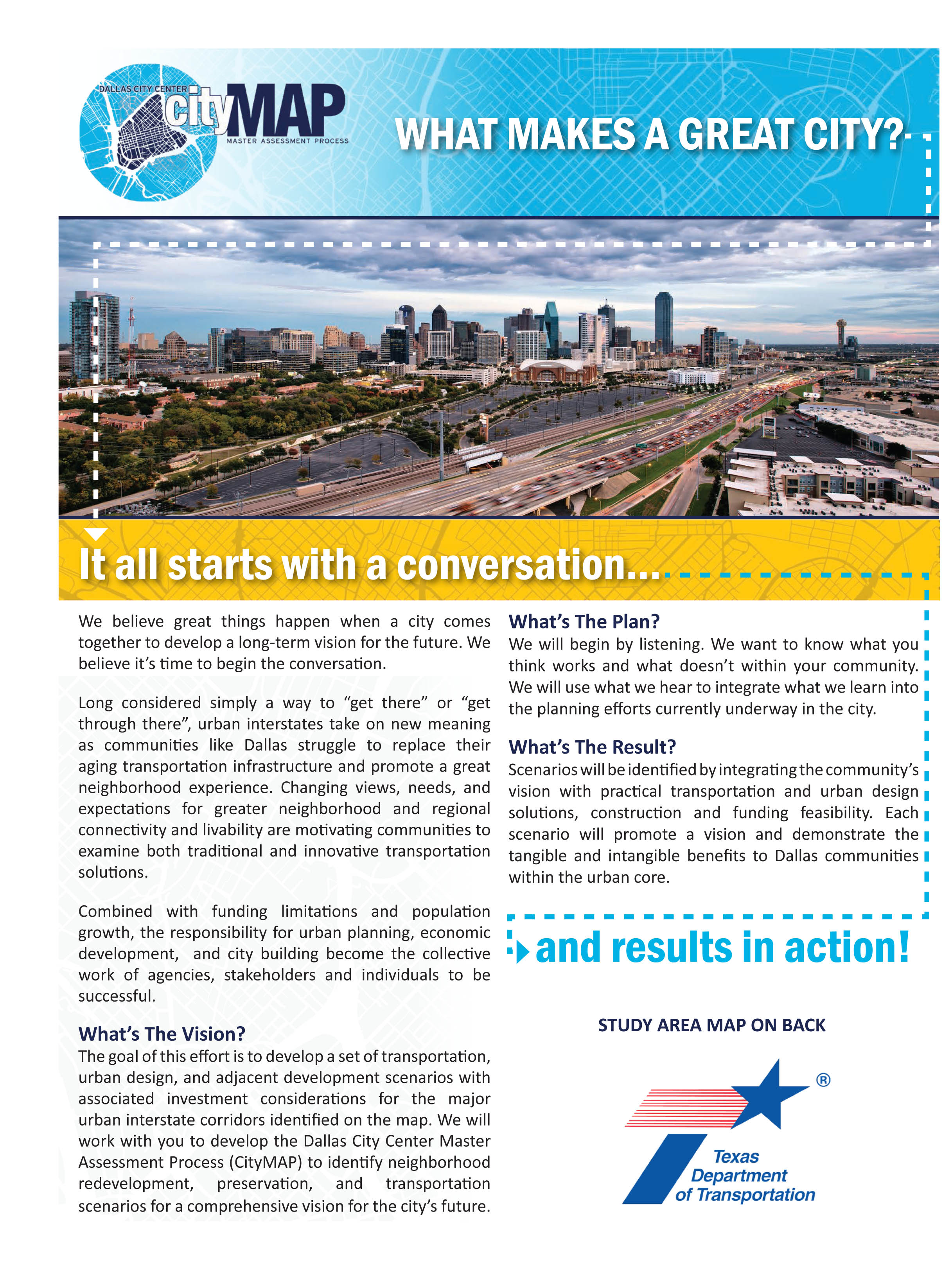
"John,  A few days ago I got this call from a guy asking me to come in and talk about Freeways and development around downtown Dallas.  He told me that folks from Texas Department of Transportation, HNTB Corporation, North Texas Council of Governments, EJES Corporation & Gateway Planning wanted to interview me about these issues.

Needless to say I was shocked because in my entire life no one has ever asked me what I thought about major transportation planning!  And what was more surprising what happened when I actually got in the room with these folks.  As a broker and developer I think I have a reliable BS detector.  I believe they were truly interested in my opinions about downsizing roads, removing freeways, how to build more complete streets, the need for small scale improvements, and for anticipating the impacts of incremental urbanism and entrepreneurial wealth building on the quality of life for people in our region.  The bottom line is, things in Dallas may be changing on a much larger scale that I had thought.  I am still wondering if I dreamed this.   (Attached is the flyer they sent me)."

Dallas CityMap OnePager_Final (1)-1

I think that getting all those players to fly in something resembling a close formation is a tough job.  Anyone who has more insight as to how this is working in Dallas, please post some comments.